Broad Database Support
Supports multiple relational database dialects, plus NoSQL and vector databases through JDBC driver adapters
 MySQL
MySQL MariaDB
 PostgreSQL
 Oracle
 SQL Server
 DB2
DB2 DM
DM Xugu
Xugu Informix
 TiDB
TiDB OceanBase
 H2
H2 SQLite
 Derby
Derby HSQLDB
 ClickHouse
 Greenplum
 SAP HANA
 Hive
Hive Impala
 StarRocks
 Doris
Doris Redis
Redis MongoDB
 Elasticsearch
 Milvus
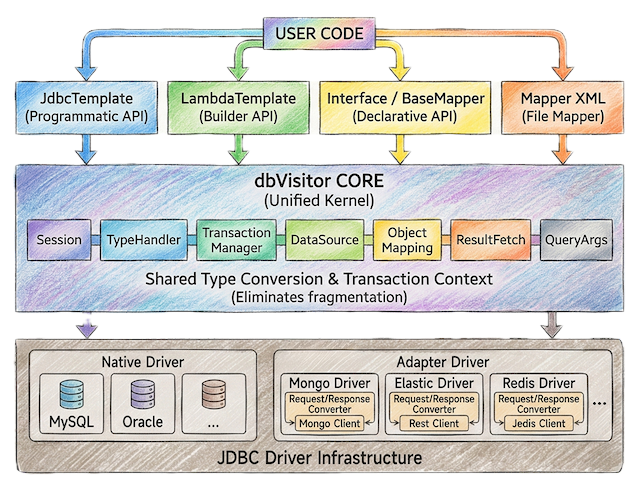
5 API Styles
Choose the best API for your scenario — all styles share the same underlying runtime mechanism.
JdbcTemplate.java
JdbcTemplate jdbc = new JdbcTemplate(dataSource);

// Query and map to Bean
List<User> users = jdbc.queryForList(
    "select * from users where age > ?",
    new Object[] { 18 },
    User.class
);

// Query single value
Long total = jdbc.queryForObject(
    "select count(*) from users",
    Long.class
);
Same APIs, Different Databases
Reuse APIs within driver capabilities; SQL, field mappings, and transaction support still depend on the data source
MySQL / PostgreSQL
// Connect to relational database
Configuration config = new Configuration();
LambdaTemplate t = config.newLambda(ds);

// Lambda query
List<User> users = t
    .query(User.class)
    .eq(User::getAge, 18)
    .queryForList();
MongoDB / Elasticsearch
// Connect to NoSQL database (same API)
Configuration config = new Configuration();
LambdaTemplate t = config.newLambda(ds);

// Exact same Lambda query
List<User> users = t
    .query(User.class)
    .eq(User::getAge, 18)
    .queryForList();
Dual-Layer Adapter Architecture
Application layer manages query differences, Protocol layer manages communication differences
Use different levels of API to solve different levels of problems — respect and manage data source differences.
Quick Start
Add the core library and your JDBC driver; the example uses the latest release
pom.xml
<dependency>
  <groupId>net.hasor</groupId>
  <artifactId>dbvisitor</artifactId>
  <version>6.8.2</version>
</dependency>