Broad Database Support
Covers 11 relational database dialects, plus NoSQL and vector databases via JDBC driver adapters
MySQL
PostgreSQL
Oracle
SQL Server
DB2
ClickHouse
TiDB
OceanBase
DM
StarRocks
Doris
Redis
MongoDB
Elasticsearch
Milvus
Core Philosophy
Use different levels of API to solve different levels of problems — respect and manage data source differences.
🔗
Unified APIs
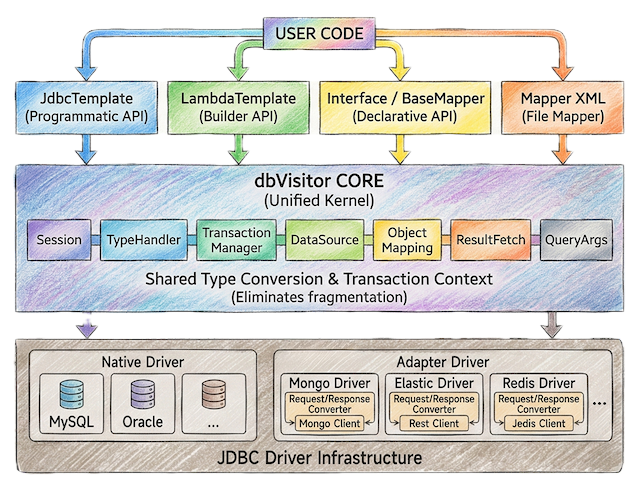
Programmatic, Declarative, Mapper, XML File — 5 API styles
📐
Dual-Layer Adapter Architecture
Application access layer, standard driver layer, independent evolution, independent use
🧩
Zero Coupling
Complex or simple, free integration, use anywhere
Dual-Layer Adapter Architecture
Application layer manages query differences, Protocol layer manages communication differences
5 API Styles
Choose the best API for your scenario — all styles share the same underlying runtime mechanism.
JdbcTemplate.java
JdbcTemplate jdbc = new JdbcTemplate(dataSource);

// Query and map to Bean
List<User> users = jdbc.queryForList(
    "select * from users where age > ?",
    User.class,
    new Object[] { 18 }
);

// Query single value
Long total = jdbc.queryForObject(
    "select count(*) from users",
    Long.class
);
Same APIs, Different Databases
Whether the underlying database is MySQL or MongoDB, the application code stays the same
MySQL / PostgreSQL
// Connect to relational database
Configuration config = new Configuration();
LambdaTemplate t = config.newLambda(ds);

// Lambda query
List<User> users = t
    .lambdaQuery(User.class)
    .eq(User::getAge, 18)
    .list();
MongoDB / Elasticsearch
// Connect to NoSQL database (same API)
Configuration config = new Configuration();
LambdaTemplate t = config.newLambda(ds);

// Exact same Lambda query
List<User> users = t
    .lambdaQuery(User.class)
    .eq(User::getAge, 18)
    .list();
Quick Start
Just one Maven dependency to get started
pom.xml
<dependency>
  <groupId>net.hasor</groupId>
  <artifactId>dbvisitor</artifactId>
  <version>6.7.0</version>
</dependency>