
Unified Data Access: Layers and Limits
After dbVisitor: Many Databases, One API went live, the core debate was direct: can a single API truly unify RDBMS and NoSQL? This post tackles the controversy and explains the design principles behind dbVisitor's "One API, Access Multiple Databases" vision.
Invocation style is unified, not database semantics. Builders require dialect support, and native commands must be supported by the adapter. Before integrating an ORM or connection pool, check the JDBC methods it requires. See the feature matrix and JDBC limitations.
I. API Design Pitfalls
To understand why "Grand Unification" is feasible, we first need to clarify two misconceptions that have long confused the public.
1. Business-Level APIs
In the current Java database access field, there is an obvious trend: APIs are becoming more and more "Business-Oriented".
Business-Level Design
To solve complex query problems in specific domains, database access frameworks have begun to pursue extreme development efficiency. For example, excellent projects like Easy-Query and SqlToy-ORM. SqlToy-ORM excels in dealing with extreme pagination optimization, cache translation, and hierarchical data queries (such as recursive queries), often solving headache-inducing SQL problems with minimal configuration; while Easy-Query achieves the ultimate in type-safe dynamic query construction, allowing you to write extremely complex business logic in Java code in a structured way.
- Value: For complex queries in specific domains (such as multi-table joins, dynamic aggregation, row-to-col conversion), they can even replace dozens of lines of native SQL with very little code. This efficiency improvement is huge and deserves full recognition.
- Limitation: These "artifact" level APIs are often strongly bound to the characteristics of the database. The complex query logic of MySQL is completely unworkable when copied directly to MongoDB or Elasticsearch.
Core Data Operations
Looking back at Hibernate, MyBatis, Commons DBUtils, and even JDBC itself, these enduring projects all have one thing in common: Single Responsibility, Clear Goal. They do not do business logic, but focus on being the Foundation.
The huge success of MyBatis Plus in China is built on the solid "non-business-oriented" foundation of MyBatis. MyBatis is responsible for mapping, and MP is responsible for providing more advanced features and encapsulation.
The value of universality lies in making the "skeleton of the house". dbVisitor's goal is not to replace tools like Easy-Query to solve specific business complex queries, but aims to become the Data Access Foundation of the new era. Only when the foundation is solid and unified can the upper-layer business ecosystem (like the MyBatis ecosystem) blossom on different data sources.
2. Simple APIs Matter
Opponents often hold two views:
- "CRUD is too simple, unifying it has no value"
- "Unified API cannot cross the gap of database features"
The Value of CRUD
If your world only has MySQL and Oracle, then indeed, JDBC has already unified it, and reinventing the wheel is meaningless. But what if your technology stack adds MongoDB, Elasticsearch, Redis?
- MongoDB inserts a piece of data using
db.collection.insertOne() - Elasticsearch inserts a piece of data using
IndexRequest - Redis inserts a piece of data using
setcommand
These "simple" operations have vastly different API styles. With the vision of "One API, Access Multiple Databases", being able to complete all the above operations through a unified JDBC/Mapper invocation style (Redis uses commands, not entity insert builders) has extremely high universal value in itself, eliminating the cost of cognitive switching.
Beyond Query Builders
This is a huge cognitive misunderstanding: "Unified API" does not equal "Unified into a specific interface".
- Is a query builder an API? Of course!
- Is a Mapper interface (Dao) an API? Of course!
- Is MyBatis's Mapper XML binding an API? Of course!
- Is the underlying
JDBC Connectionan API? Even more so!
People despise Mapper + XML often because it is cumbersome to write (repetitive labor), but at the architectural level, Mapper Interface Binding DSL is the API design that best fits "Behavior-Centric". It separates "Business Intent" (Method Name) from "Specific Implementation" (SQL/DSL).
As long as we no longer obsess over describing all queries with Java code, but accept the concept of "API Defines Behavior", the gap crossing database features can be easily solved.
II. Unified Access
There is no silver bullet, and any attempt to invent a "Universal Java Syntax" to generate all database queries is doomed to fail.
The reason why dbVisitor dares to say "Yes" is that its core idea is not to Eliminate Differences and seek to invent a universal syntax, but to Manage Differences through JDBC Standardization and Layered Abstraction.
1. Two-Layer Adapter
dbVisitor adopts a unique double-layer architecture to bridge the gap:
JDBC Standardization
This layer is the foundation for dbVisitor to achieve the vision of "One API, Access Multiple Databases".
- Reuse JDBC Standard: No new protocol was invented, but drivers following the JDBC specification were written for NoSQL (MongoDB, Elasticsearch, Redis). And use the official original DSL language of these databases for database operations. These drivers internally merely map JDBC operations to their respective native SDK calls and map the return values into JDBC standard ways.
- Request/Response Model: To simplify the access of heterogeneous data sources, complex JDBC state management is simplified into a lightweight Request/Response Model. This makes it possible to access a completely new non-standard data source with very little code. New data sources can even be directly managed by HikariCP. Use the adapter's supported commands and JDBC methods, not the entire relational JDBC feature set.
The Elasticsearch adapter reuses common JDBC state management and concentrates data-source-specific code in command parsing and execution.
One API
The "One API" here does not refer to covering everything with a rigid interface, but rather to building a Unified Data Interaction Standard. dbVisitor's design philosophy believes that true unification is not to force all database operations into the same narrow entrance, but to provide a unified experience in different dimensions through Layered Abstraction.
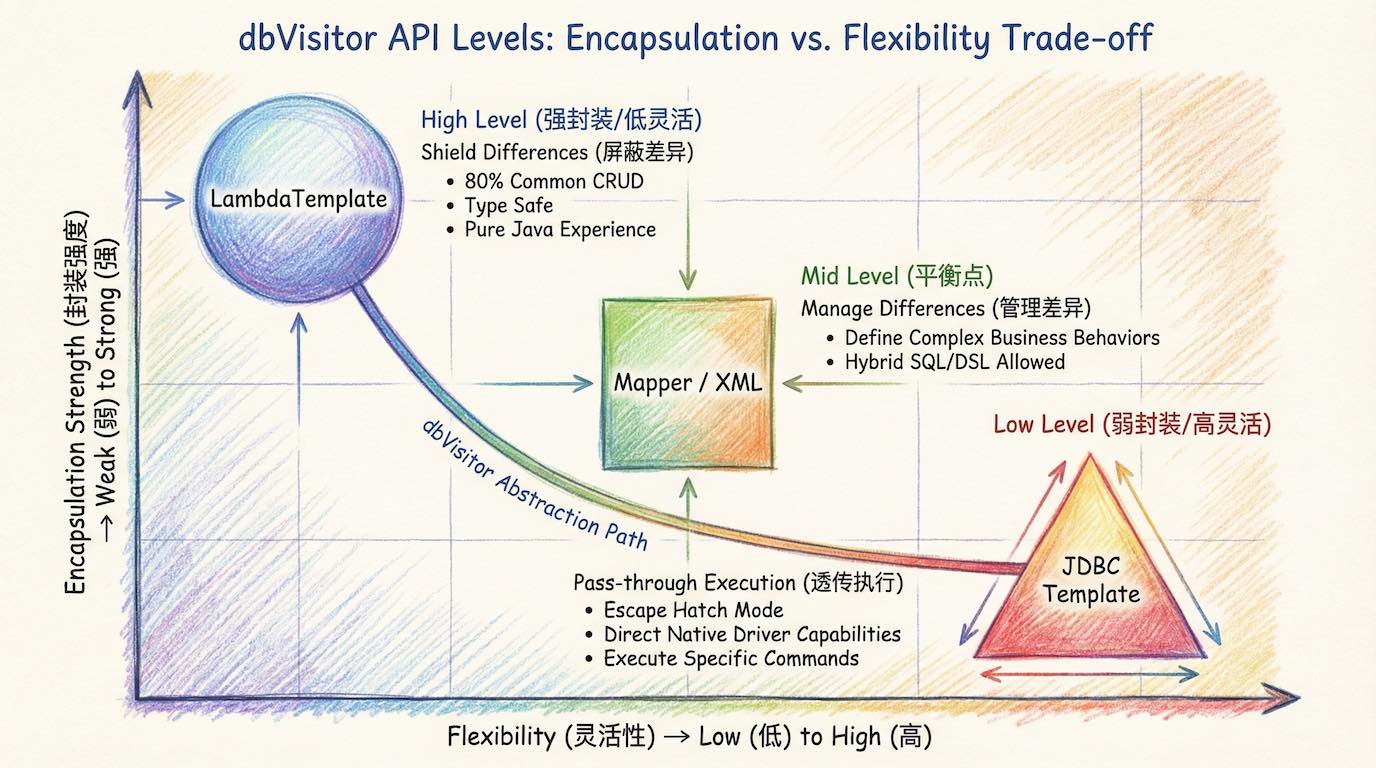
The diagram's layers and proportions illustrate abstraction, not feature coverage or performance statistics. JdbcTemplate executes driver-supported statements; it does not translate arbitrary SQL into arbitrary database commands.
dbVisitor designs abstract interfaces of different levels for different scenarios to meet different behavioral needs:
-
LambdaQuery (Shield Differences)
- Scenario: 80% daily CRUD.
- Advantage: This is the Most "Grand Unified" layer. It completely shields the differences in underlying query languages. You only need object-oriented programming without caring whether the underlying is MySQL or NoSQL.
-
Mapper / XML (Manage Differences)
- Scenario: Complex statistics, aggregation, and associated queries.
- Advantage: This is the Most "Compatible" layer. It follows the classic pattern of MyBatis (Interface Defines Behavior + XML Defines Logic), allowing you to use the full power of native dialects (SQL or JSON DSL) of the database instead of trying to simulate them with Java.
-
JDBC Template (Pass-through Execution)
- Scenario: Database-specific management commands or native Shell scripts.
- Advantage: This is the Most "Flexible" layer. It allows you to penetrate the framework directly, talk to the underlying driver, and execute commands listed in the adapter's syntax manual.
Although dbVisitor unifies call forms like insert/update/commit, it cannot change the physical characteristics of the underlying database. dbVisitor's MongoDB and Elasticsearch adapters do not expose JDBC transactions; commit()/rollback() cannot manage transactions through them. This is an adapter boundary, not a claim that MongoDB servers lack transactions.
III. API Examples
Let's look at how this concept lands through code.
1. Type-Safe Queries
Regardless of whether the underlying is MySQL or Elasticsearch, standard CRUD code is completely identical.
// Unified Insertion
template.insert(UserInfo.class)
        .applyEntity(new UserInfo("1001", "dbVisitor"))
        .executeSumResult();

// Unified Query
List<UserInfo> list = template.query(UserInfo.class)
        .eq(UserInfo::getAge, 18)  // Automatically translated to SQL / QueryDSL / Bson
        .queryForList();
The MySQL and Elasticsearch examples require their own data sources and Mappers; one Session does not switch databases automatically.
2. Mapper Methods
When we need to leverage ES aggregation capabilities or MySQL complex joins, the Mapper interface is the best choice. dbVisitor provides three postures for using Mapper, which can be mixed flexibly according to business complexity.
Java Builders
This is one way in dbVisitor. By inheriting BaseMapper and using Java 8's default methods, you can directly use the query builder inside the Mapper interface to complete DAL logic. This method avoids the tediousness of XML and does not hardcode SQL in Java files like annotations, perfectly realizing "Zero SQL" development.
@SimpleMapper
public interface UserMapper extends BaseMapper<UserInfo> {

    // Pure Java code constructs query logic, without XML and SQL
    default List<UserInfo> findActiveUsers(int minAge) throws SQLException {
        return this.query()
                   .eq(UserInfo::getStatus, "ENABLE")
                   .gt(UserInfo::getAge, minAge)
                   .queryForList();
    }
}
Method Annotations
For moderately complex queries, using annotations directly on interface methods is the most concise way. You don't need to write extra XML files to complete SQL or DSL binding.
@SimpleMapper
public interface SqlUserMapper extends BaseMapper<UserInfo> {
    @Query("select * from user_info where age > #{age}")
    List<UserInfo> findByAge(@Param("age") int age);

    @Insert("insert into user_info (name, age) values (#{name}, #{age})")
    int insertUser(@Param("name") String name, @Param("age") int age);
}

@SimpleMapper
public interface ElasticUserMapper extends BaseMapper<UserInfo> {
    @Query("POST /user_info/_search {\"query\": {\"term\": {\"age\": #{age}}}}")
    List<UserInfo> searchByAge(@Param("age") int age);
}
Create these two mappers from sessions bound to their respective databases. Mapper methods do not switch data sources automatically.
Mapper Files
When SQL becomes extremely complex (such as hundreds of lines of report SQL), or when the company has a strict DBA review process (need to separate SQL files), XML is still an irreplaceable solution.
Java Interface (Define Behavior):
@RefMapper("mapper/user-mapper.xml")
public interface UserMapper {
    // This is a business intent: Count age distribution
    List<Map<String, Object>> groupByAge(@Param("minAge") int minAge);
}
XML Implementation (Define Logic): Choose one of the XML fragments below and place it in a mapper whose namespace references the interface. Do not define the same statement ID twice in one file. Elasticsearch aggregation responses differ from SQL grouped rows; read the aggregation response according to the driver manual.
<!-- If MySQL -->
<select id="groupByAge">
    SELECT age, count(*) FROM user_info WHERE age > #{minAge} GROUP BY age
</select>

<!-- If Elasticsearch (Write JSON DSL directly) -->
<select id="groupByAge">
    POST /user_info/_search
    {
        "query": { "range": { "age": { "gt": #{minAge} } } },
        "aggs": { "age_group": { "terms": { "field": "age" } } }
    }
</select>
3. Native Access
This is dbVisitor's "Escape Hatch". When all upper-layer abstractions cannot meet your special needs, such as needing extreme performance optimization, using database-specific non-standard commands, or integrating third-party frameworks like QueryDSL, you can retreat to this layer.
Native Commands
Use the target data source's command style. NoSQL adapters still parse supported commands and call the SDK; they do not pass through arbitrary Shell or JavaScript programs.
JdbcTemplate jdbc = new JdbcTemplate(connection);

// MySQL
jdbc.queryForList("select * from user where id = ?", 1);

// MongoDB (Directly write Mongo Shell)
jdbc.queryForList("db.user.find({_id: ?})", 1);
Underlying APIs
You can break the encapsulation at any time and operate the underlying Connection directly. For NoSQL data sources, dbVisitor's driver layer also follows the standard JDBC Wrapper specification, allowing you to unwrap the official native driver object.
// Get Standard JDBC Interface
try (Connection conn = jdbcTemplate.getDataSource().getConnection()) {
    if (conn.isWrapperFor(MongoClient.class)) {
        MongoClient client = conn.unwrap(MongoClient.class);
        // Use the client within the connection lifetime; do not close it separately.
    }
}
IV. Architecture
Many people will ask: "Isn't this just stitching MyBatis and Spring together?" Actually not. dbVisitor is not simple "glue", but a Redesign based on a unified architecture.
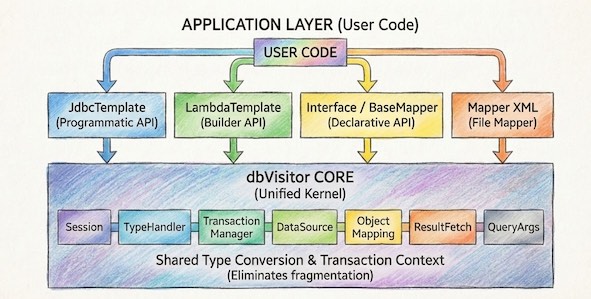
1. Independent Layers
dbVisitor is One API + Driver. Even if you don't intend to replace your current MyBatis, you can still use dbVisitor's JDBC Driver independently. Use MyBatis to map driver-supported commands. Plugins requiring transactions, Batch, or complete metadata are not automatically compatible.
2. Shared Foundation
If you have tried mixing MyBatis and Spring JDBC in a project, you will find a strong sense of fragmentation:
- MyBatis's
TypeHandlercannot be used in Spring JDBC. - Spring's
RowMappercannot be reused in MyBatis. - Transaction manager coordination often has pitfalls.
JDBC Template, LambdaQuery, and Mapper XML all share the same TypeHandler Mechanism, same Session Management, and same Metadata Mapping. In dbVisitor, you can reuse the ResultMap defined by Mapper in Lambda queries. This underlying consistency is unmatched by simple piecing together.
3. Framework Agnostic
This is another important feature that distinguishes dbVisitor from Spring Data or MyBatis-Plus. dbVisitor's core does not depend on Spring, nor does it depend on any Web container. It is built based on pure Java and JDBC standards. This means:
- You can use it in Spring Boot.
- You can use it in Solon, Vert.x, Quarkus.
- You can even
newit out and use it directly in a Main Method console program without any dependencies.
This zero-coupling feature allows it not only to adapt to various existing technology stacks but also to maintain vitality in future architectural evolution, not being bound to the chariot of a specific framework.
Conclusion
Physics tells us to respect differences, but software engineering tells us to manage complexity through abstraction.
dbVisitor does not try to use "Grand Unification" to cover up database features, but through providing a Unified Foundation (JDBC Driver) and Layered API Design, it lets developers enjoy the convenience of "Grand Unification" in simple scenarios and possess "Native-Level" control in complex scenarios.
This is dbVisitor's confidence to challenge data access "Grand Unification".